
The Facts About Shoulder Arthroscopy
Your shoulder is an important part of your body. It helps to move your arm, so that you can perform tasks such as lifting, writing and more.
The shoulder is a complex joint that allows your arm to move in many directions. It is made up of several important parts that work together to support strength and motion.
Bones of the Shoulder
The shoulder includes four main bones:
- Humerus – the upper arm bone
- Scapula – also called the shoulder blade
- Clavicle – also known as the collarbone
- Sternum – the breastbone, which connects to the clavicle
Shoulder Joints
The shoulder has three main joints. These joints allow lifting, rotating, and reaching movements.
- Glenohumeral joint – the main ball-and-socket joint of the shoulder
- Acromioclavicular (AC) joint – where the clavicle meets the shoulder blade
- Sternoclavicular (SC) joint – where the clavicle connects to the sternum
Soft Tissues in the Shoulder
Several soft tissues help cushion and stabilize the shoulder:
- Cartilage helps protect the bones and allows smooth movement
- Bursa are small fluid-filled sacs that reduce friction
- Muscles and tendons, including the rotator cuff, help control movement and support the joint
Because the shoulder has many moving parts, injuries and conditions can occur. These may include torn cartilage, rotator cuff injuries, and bone spurs. When these problems develop, they can affect how well the shoulder moves and functions.

What is Shoulder Arthroscopy?
Orthopedic surgeons can diagnose and treat many different shoulder conditions with arthroscopy, which can allow patients to benefit from less tissue damage, shorter recovery times, less scarring and less post-operative pain. This technique also avoids cutting any muscles or tendons in order to gain access to the affected area. After the issue is thoroughly checked, via diagnostic tests and imaging, and it is determined that surgery is necessary, shoulder arthroscopy may be an attractive option as opposed to traditional surgery.
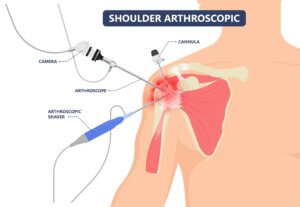
During a shoulder arthroscopy, your doctor will insert an arthroscope, a tiny camera, into your shoulder to properly assess the joint and all areas above it including the ligaments, tendons, bones and cartilage. If there is any damaged tissue, the doctor may need to remove it, whereas with torn muscles, tendons, or cartilages, small instruments will be utilized.
To specifically repair a rotator cuff that is torn, your doctor will attempt to reattach the tendon to the bone. The tendon is reattached with sutures, which are then connected to small rivets in the bone. These rivets are usually made up of metals or dissolvable materials and do not need to be removed.
How long do you wear a sling after shoulder arthroscopy?
After the procedure, your doctor will advise you to wear a sling. The sling or immobilizer will help keep the shoulder from performing any harsh movements that would prevent it from healing. The length of time the sling is needed varies with the procedure performed
Shoulder Arthroscopy Recovery Timeline
Recovery after shoulder arthroscopy varies from person to person and depends on what was treated during the procedure. On average, recovery can take anywhere from 1 to 6 months. Patients who have a repair may need more time than those who had minor tissue clean-up.
While shoulder arthroscopy can help relieve pain and improve movement, it may not be the right option for every condition. Some shoulder problems may require traditional surgery. Your doctor will recommend the most appropriate treatment based on your specific needs.
How long do you wear a sling after shoulder arthroscopy?
Most patients wear a sling or immobilizer for at least one week. If a repair was performed, your doctor may recommend wearing it longer to protect healing tissues.
Typical recovery timeline
- First 1–2 weeks: Swelling and soreness improve; daily activities are limited
- Weeks 3–6: Range of motion slowly improves with guidance
- 2–6 months: Strength and function continue to return
If a repair was done, physical therapy is often recommended to help restore motion and strength safely. Recovery time varies by patient, procedure, and activity level. Consult an orthopedic provider for a tailored care plan.
Frequently Asked Questions About Shoulder Arthroscopy
How long is shoulder arthroscopy surgery?
Shoulder arthroscopy usually takes about 45 minutes to 1 hour, depending on what needs to be treated. More complex repairs may take longer.
How much does a shoulder arthroscopy cost?
The cost of shoulder arthroscopy varies based on insurance coverage, the facility, and the type of procedure performed. Your doctor’s office and insurance provider can help explain expected costs ahead of time.
How long off work after shoulder arthroscopy?
Some patients return to desk work within a few days to a week, while physically demanding jobs may require several weeks or longer. Your doctor will recommend a timeline based on your specific case.
How painful is shoulder arthroscopy?
Most patients experience some pain and soreness after surgery, especially during the first few days. Pain may be managed with medication and/or therapy and gradually improves as healing continues.
How to sleep after a shoulder arthroscopy?
Many patients find it easier to sleep propped up with pillows or in a recliner during early recovery. Wearing a sling at night may also help keep the shoulder supported.
About South Island Orthopedics
South Island Orthopedics serves patients across Long Island from Cedarhurst and Rockville Centre, NY. If joint pain or injury is interfering with daily life, an evaluation can help determine appropriate next steps. Appointments can be requested online or by calling the office directly at 516-295-0111.
Tagged with: liorthosports, long island orthopedic surgery, long island orthopedics, orthopedic & sports associates of long island, orthopedic surgery, Shoulder Arthroscopy, shoulder surgery
Posted in: Neck/Back & Shoulder